

Jessica Trainor
Head of PartnershipsProximic by Comscore
One of the clearest shifts I’ve seen in recent years is how naturally audio has become part of everyday life.
You can start your day with a news program during the morning commute, fill your ears with true crime while you work out or prep meals for the week, and even close out the day on a Zen note with a guided evening meditation routine.
As this range of content and adoption continues to expand, so does its inherent value to advertisers as a piece of the broader media mix. While the engagement levels within podcasts are some of the highest in the connected ecosystem, we have yet to see the ad dollars shift into this vital medium in the same way it has for other channels.
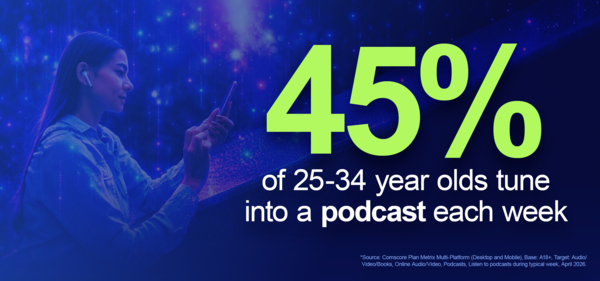
Why haven’t advertising dollars shifted to audio more quickly?
The challenge hasn’t been audience engagement, but rather the infrastructure around it. Broad content classifications, inconsistent standards across platforms, limited transparency, and fragmented measurement have made audio harder to activate alongside other channels.
That is where Proximic by Comscore’s new integrations with Spotify, SiriusXM, Triton Digital, Acast, and Libsyn come in. By bringing transcript-level targeting and measurement across a broad cross-section of premium audio inventory, Proximic helps reduce the complexity for buyers and makes audio easier to plan, activate, and evaluate alongside display, video, CTV, and other channels.
The result is an expanded intelligence layer designed to move audio more fully into the world of omnichannel activation.
Why episode-level, and why now?
When we look at the traditional buying model for podcasts, it has primarily been focused on the show or genre level where a buyer might target “true crime” or “business,” for example, and hope the specific episode aligns with the brand. But any regular podcast listener knows that a single episode, especially a long one, has potential to cover a lot more ground than its show title or genre suggests. For buyers accustomed to the precision available across display, video, and CTV, relying on broad podcast labels can feel limiting. It's like asking an artist to paint with a single oversized brush after years of using finer, more intricate tools.
Proximic’s transcript-level intelligence provides a much clearer view. Rather than relying on a basic keyword scan, it analyzes the full episode transcript to understand the meaning and context of what is actually being discussed. Those insights are then translated into standard IAB content categories, enriched with Predictive Audiences and brand safety and suitability classifications, then packaged into pre-bid segments that buyers can activate programmatically.
The benefit for advertisers is not only greater precision and expanded reach, but the ability to uncover relevant inventory beyond the obvious shows or genres they may have selected on their own.
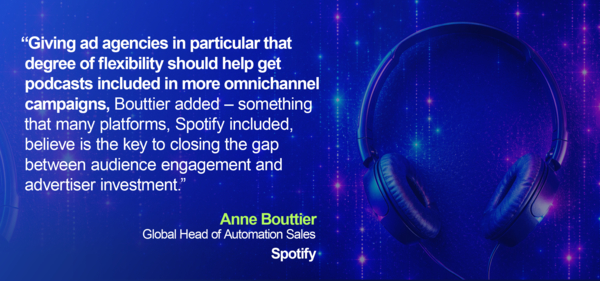
As Anne Bouttier, global head of automation sales at Spotify, told AdExchanger, that added flexibility can help audio play a larger role within the broader media mix:
One standard, across every major platform
What makes these new integrations important beyond any individual partner is the consistency it brings to audio activation. Using one methodology across Spotify, SiriusXM, Triton Digital, Acast, and Libsyn gives buyers a common framework for understanding content at the episode level, rather than piecing together different classifications for every publisher relationship.
This framework helps audio fit more naturally into omnichannel campaigns by applying the same ID-free audience, contextual category, and brand suitability targeting approach across audio, display, video, and CTV. Buyers can extend campaigns built around a particular audience, cultural moment, or theme into audio using the same underlying approach, which subsequently adds incremental reach and engagement to campaigns without requiring a separate strategy with disparate rules and conditions.
According to Comscore campaign measurement data, on average, approximately 10% of incremental, exclusive digital reach came from audio inventory.**
Deeper episode-level intelligence unlocks new monetization opportunities for publishers by identifying valuable inventory beyond their most recognizable shows. With greater visibility into the topics and themes discussed within each episode, advertisers can more confidently scale their campaigns across a broader range of podcast content, discovering high-quality, relevant inventory that may have previously been overlooked. This expanded reach enables more precise audience alignment while helping publishers maximize the value of their full catalog.
Building the foundation for agentic buying
Looking ahead, the opportunity extends far beyond improving campaign performance in audio today. As media buying becomes increasingly agentic driven, the value of comprehensive, interoperable intelligence will only grow. The systems guiding these decisions will rely on rich, standardized signals that can evaluate opportunities across channels and inventory sources at scale.
Transcript-level intelligence better positions Proximic to play a critical role in this evolution by transforming audio into a channel that can be understood, evaluated, and activated with the same level of precision expected across the rest of the programmatic ecosystem. This is ultimately about helping audio to be more fully represented in the next generation of media buying.
Podcast engagement has never been the primary challenge. What advertisers have needed most is a consistent intelligence layer that brings greater transparency, precision, and confidence to audio activation.
Audio’s next chapter is already taking shape. The audience is there, the engagement is there, and now the infrastructure is evolving with it.
*Source: Comscore Plan Metrix Multi-Platform (Desktop and Mobile), Base: A18+, Target: Audio/Video/Books, Online Audio/Video, Podcasts, Listen to podcasts during typical week, April 2026.
**Source: Comscore Campaign Ratings, Aug 2025